Jun 17 / Global Solutions Education and Training Academy

SMART Goals and Hybrid Learning Programs for Workforce Development and Organizational Success

Use SMART goals and hybrid training to boost workforce performance. Add coaching, reflection, and mentorship for real results. Learn how.

Key Takeaways

  • SMART goals connect strategic priorities to measurable education, development, and training outcomes

  • Hybrid formats improve access and adoption while protecting quality through structure and support

  • Reflection, coaching, and mentorship turn training activity into leadership, team, and organizational performance

When training is happening but workforce results stay flat

Courses are running, attendance looks fine, and completion certificates keep coming, but the numbers you care about barely move. A supervisor still spends 30 minutes rechecking the same reports, customer issues still bounce between teams, and new hires still leave within the first 90 days.


A common benchmark is that many organizations track completion rates because they are easy to report, but impact measures tend to improve only when goals and implementation are clearly defined. If you do one thing, stop treating attendance as the goal and start treating it as a signal that your program has reach, not results.


So before you schedule another round of courses, define what “better” looks like in work terms and how you will measure it. 


By the end of this section, you will be able to set SMART goals (Specific, Measurable, Achievable, Relevant, Time-bound) and sketch a hybrid program plan that links learning to measurable workforce outcomes.

Common reasons results stay flat, and the fix you can apply quickly:


  • Training topics are broad, so learners cannot apply them on Monday morning → pick 1 to 2 job tasks and design practice around them

  • Metrics track activity (completion) instead of performance (quality, speed, retention) → add one work metric per goal, like error rate or time-to-competency

  • Learners do not get time to practice at work → schedule 15 to 30 minutes of on-the-job practice per week with a manager check-in

  • A single format is used for everyone → use hybrid delivery: short live sessions for practice plus self-paced modules for background


Here’s the catch: these fixes work best when managers agree to protect practice time and reinforce the same expectations. They often fail when training is treated like an event and no one owns follow-through after the course ends.

Use SMART goals to turn strategy into measurable learning and performance outcomes

Next, you need a way to connect big priorities to what people do on a Tuesday afternoon.

SMART goals (specific, measurable, achievable, relevant, time-specific) help you translate strategy into role-level targets that can be coached, tracked, and improved. The key is to write goals that describe observable work behavior and a business result, not just “finish the course.”

Translate priorities into role-based SMART goals

Start with one strategic priority and write 2 to 3 SMART goals per role that directly affects it. If you do one thing, do this: assign a single owner for each goal (team lead, manager, or program owner) so progress does not disappear between training and the day job.


For example, if the priority is faster customer response, goals might look like:


  • Customer support rep: Reduce average first-response time from the current baseline to the target level within 60 days, measured weekly, with the team lead reviewing a 10-case sample each Friday

  • New supervisor: Run one 30-minute coaching session per direct report each month for 3 months, documented in a shared log, tied to a defined performance metric like rework or escalations

  • Warehouse associate: Follow the updated pick-pack checklist with at least 95% accuracy over 4 consecutive weeks, verified by weekly spot checks from a shift supervisor


Here’s the catch: SMART goals work best when learners have enough control over the outcome (like call handling steps or checklist use) and fail when results depend on factors they cannot influence (like a backlog caused by staffing). When that happens, keep the learning goal behavioral (what to do) and track the business metric separately as a shared team outcome.

Measure more than completion

Completion is a weak signal because it does not tell you if someone can do the work. Track at least one measure of skill and one measure of on-the-job impact, and set a simple review cadence like weekly for 4 weeks, then monthly.


Common measures used in workforce programs include:


  • Proficiency: score on a role-based scenario, hands-on demo, or manager observation checklist (for example, 8 of 10 steps done correctly)

  • Productivity: time to complete a task, throughput per shift, or cycle time (measured against the person’s own baseline first)

  • Quality: error rate, rework, audit findings, or defect count

  • Customer outcomes: response time, customer satisfaction trend, fewer escalations

  • Safety: near-miss reports, incident rate, correct PPE use during spot checks

  • Retention: 30/60/90-day retention for new hires, internal mobility, or time-to-competency


If you’re short on time, skip building a complex dashboard. Use a one-page scorecard that lists each SMART goal, the metric, the owner, and the check-in date, then review it in a 15-minute weekly stand-up.

A common mistake is setting targets before you know your baseline. Fix it by taking 1 to 2 weeks to measure the current level first, then set a realistic target and timeline based on the gap.


Design a hybrid program that fits real learners and real work

Next, design the mix around the outcomes, not around what is easiest to schedule. A common mistake is to label a program “hybrid” and then copy the same content into three formats, which adds time without improving performance.


If you do one thing, map each learning objective to the format that best supports it: online for knowledge recall, live sessions for practice and feedback, and on-the-job work for real transfer. This works best when the job has repeatable tasks and managers can observe progress, but it fails when learners cannot get time on task at work.


Choose the right channel by topic and skill type using a simple decision check:


  • Foundations and terminology: self-paced online (10 to 20 minutes per module)

  • Judgment and problem solving: live virtual workshop with breakouts (60 to 90 minutes)

  • Physical or high-stakes tasks: in-person practice with a checklist (30 to 60 minutes)

  • Tool workflows in distributed teams: remote screen-share practice plus a job aid (20 to 40 minutes)


For example, a customer support rep can learn policy basics online, then role-play escalation scripts live, then handle 5 supervised tickets on shift. A new team lead can learn feedback models self-paced, practice hard conversations in a live session, then run two 1:1s on the job with a manager review.


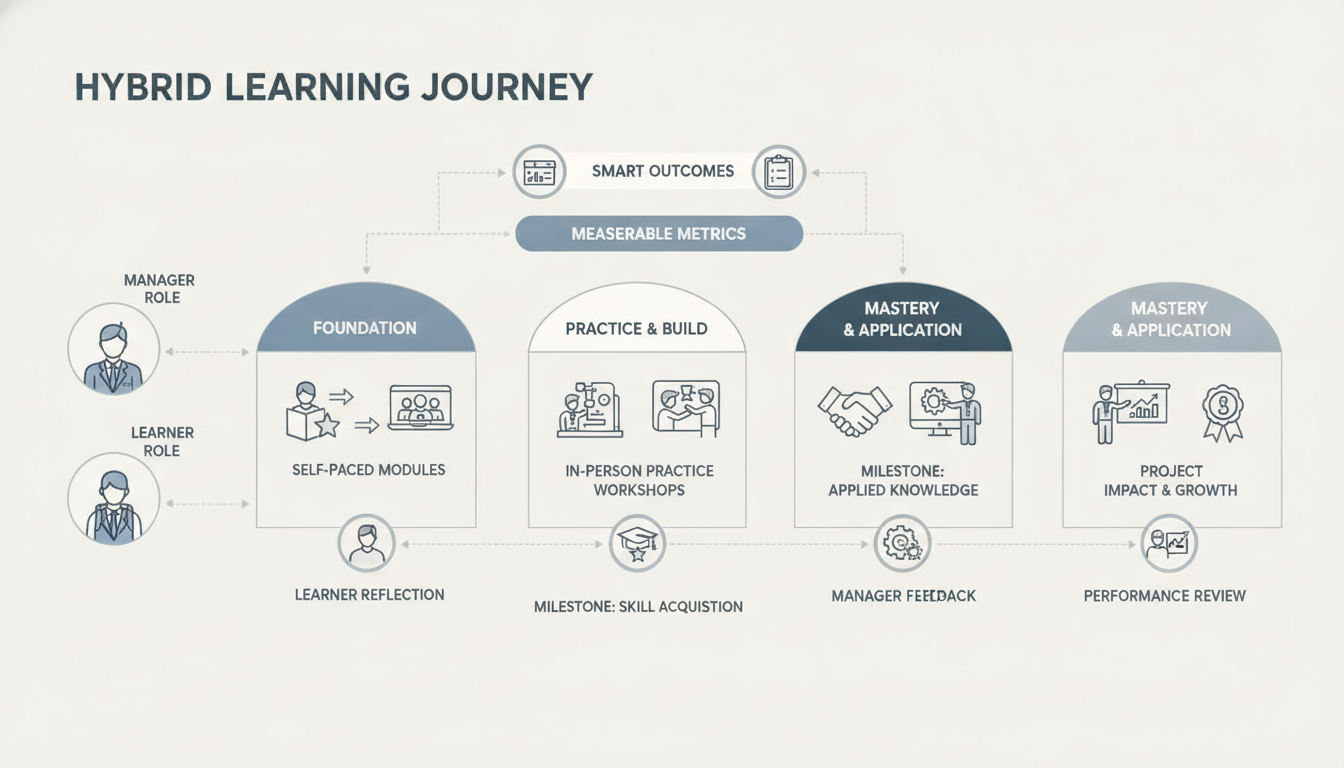
So, build the backbone in three layers so learners always know what happens next. Keep the foundation self-paced, keep practice live, and make transfer a work task with a clear standard.


  • Self-paced foundations: short lessons, a quick check (5 to 10 questions), and a printable job aid

  • Live practice: scenarios, peer feedback, and one skill score per session (for example, “asks two clarifying questions”)

  • On-the-job application: a 30-60-90 day plan tied to SMART outcomes (for example, week 2: apply the checklist twice, week 6: hit the quality benchmark, day 90: sustain the metric)


If you are short on time, skip extra content and add one tracked on-the-job assignment per week. That is where behavior change shows up, competence and confidence are built, and it gives you a direct metric to compare before and after.

Make implementation stick with reflection, coaching, and mentorship

Next, focus on what happens after the workshop or module ends. Without a repeatable way to think back on decisions and try again, even strong training shows up as short-lived effort rather than stable behavior on the job.

Structured reflection is the simplest way to make learning “usable” in real work. Give people a short prompt they can complete in 5 to 10 minutes after a shift, client call, or project milestone so barriers surface early and leaders can respond before habits set.

Embed structured reflection that reinforces learning

Also, keep reflection specific and tied to situations learners actually face. A manager running weekly check-ins will reflect on different decisions than a frontline supervisor handling schedule changes, but the same reflection format can work for both.


Use prompts like:


  • What decision did you make this week that matched the goal

  • Where did you hesitate or avoid a hard conversation

  • What slowed you down: time, tools, unclear authority, or confidence

  • What will you do differently in the next 7 days

  • What support do you need from your manager or team


Common mistake: asking for long journals or vague “what did you learn” questions. Fix it by using 3 to 5 prompts, requiring one concrete example, and ending with a single next action.

Add coaching for application and mentorship for long-term growth

That said, reflection works best when someone responds to it. Coaching is the short-cycle support that helps people apply a skill in their current role, while mentorship is the longer relationship that supports growth, belonging, and confidence over months. Both coaching and mentorship build trust and rapport within organizations and among the workforce.


If you do one thing, set a simple cadence:


  • Coaching: 15 to 20 minutes every 2 weeks focused on one current situation and one skill to practice

  • Mentorship: 30 minutes monthly focused on career direction, identity in the role, and building team capacity

  • Manager involvement: one question in regular 1:1s that connects work priorities to the program goal


Here’s the catch: coaching fails when it turns into performance evaluation. Keep it practical by agreeing on one behavior to try next week, deciding how you will notice it (for example, fewer escalations in a 2-week period), and doing a quick review in the next session.


If you’re short on time, skip long debrief meetings and do “micro-coaching” tied to real moments, like a 10-minute review after a client call or a project handoff. Over 6 to 8 weeks, these small loops build better judgment, clearer leadership communication, and stronger team follow-through.

Closing remarks

A plan without execution is a wish; learning without application is noise.


Next, bring your goals and your learning design back to the same test: can a person show the result on the job in 30 to 90 days, with the right mix of live support and self-paced practice. If you do one thing, write one SMART goal for one priority and attach it to a small set of behaviors you can observe in real work, not just course completion.


Which strategic priority needs a SMART goal and a hybrid support system so people can perform, not just participate?

Created with